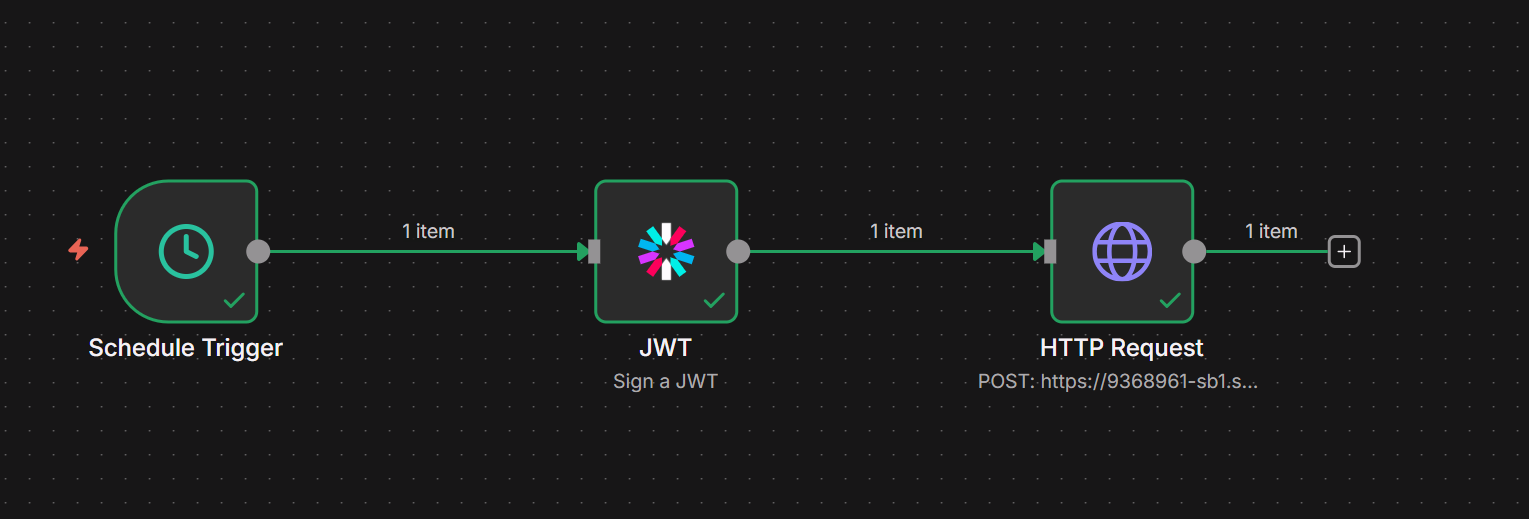
What is the best practise to connect n8n to NetSuite using Machine to Machine connection method ?
Describe the problem/error/question
I built a workflow that uses the JWT node to obtain a NetSuite access token. If I call the REST API immediately with that token, everything works. However, I’d like to avoid requesting a new token in every workflow. Ideally, one workflow would manage the token and other workflows would retrieve it when needed. Is that possible?
Share the output returned by the last node
{
“access_token”: “jpcoeijvjvpdcpk”,
“expires_in”: “3600”,
“token_type”: “Bearer”
}
Information on your n8n setup
- Running n8n via (Docker, npm, n8n cloud, desktop app): n8n cloud
Hi @Mathys_Traversier , welcome to the n8n community 
I’d probably avoid over-engineering this unless you have a very high call volume. If the token request is cheap and reliable, generating a fresh token at the start of each workflow can be totally acceptable. I’d only introduce shared token storage if you’re hitting limits, adding latency, or trying to centralize NetSuite auth management.
Thank you @Benjamin_Behrens , @tamy.santos for your valuable advices.
I think I’ll opt to generate a fresh token at the start of each workflow. Since these workflows are simple, one‑shot operations, this approach should be sufficient.
Thank you again ! 
@Mathys_Traversier
glad it helped, consider marking the best solution to let future discoverers know how to deal with this.